Stone masonry and stone veneer in Moncton
Natural stone and stone veneer on a house front, around a foundation, on steps or a fireplace. Stone lasts for generations when it’s installed properly, and the parts you don’t see (the backing, drainage and flashing) matter as much as how the stone is laid.
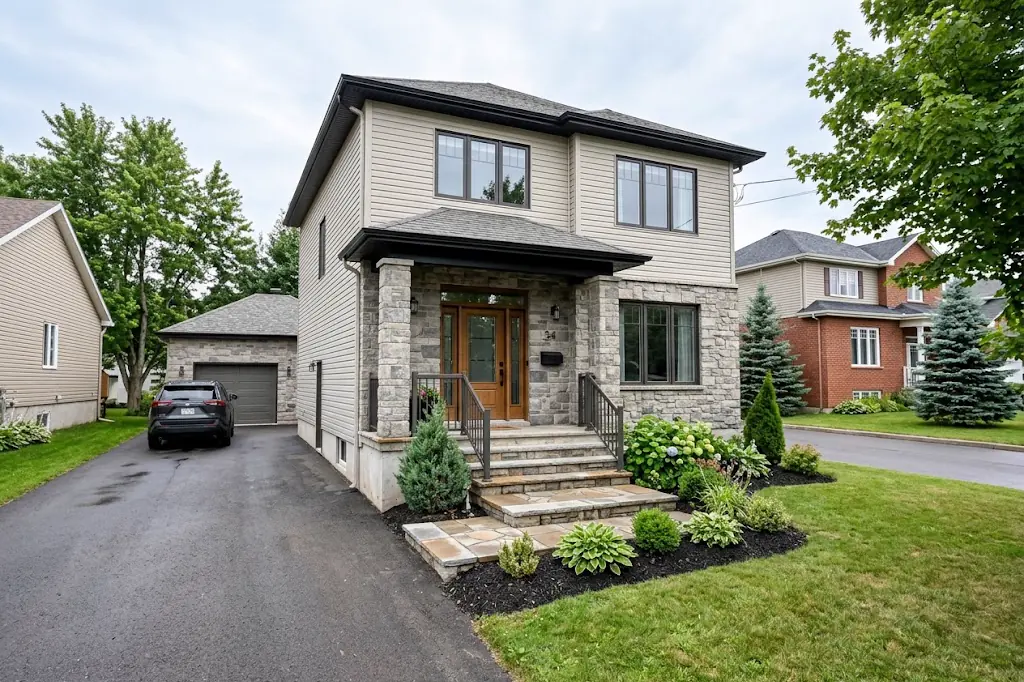
This page is about installing new stone: veneer, house fronts, steps and fireplaces. For repairing older fieldstone or sandstone, see stone restoration. For stone walls that hold back soil, see retaining walls and patios.
Types of stonework
- Full-bed natural stone
- Stone several inches thick laid in mortar, either as a structural wall or as a veneer tied to the building with a cavity behind it. Used for foundations, chimneys, garden walls and heavier facades.
- Thin natural stone veneer
- Real stone sawn to about an inch thick so it can be adhered to a wall rather than sitting on its own footing. It gives a natural look on house fronts, columns and interior walls without the weight of full stone.
- Manufactured stone veneer
- Cast concrete units moulded and coloured to look like stone. Lighter and generally less expensive than natural stone, and comes in consistent profiles with matching corner pieces.
- Dry-laid stone
- Stone stacked without mortar, used for garden walls and landscape features. A good dry-laid wall drains freely and moves slightly with frost instead of cracking.
Common choices around Moncton include granite fieldstone, Maritime sandstone in reds and greys, ledgestone and flagstone, along with a wide range of manufactured profiles.
Where stone is used
- House fronts and accent walls: stone on the lower part of a facade or around the entry, often combined with siding
- Foundation skirting: stone veneer over the exposed part of a concrete foundation instead of parging
- Columns and porch piers
- Steps and landings: natural stone treads and risers on a concrete base
- Fireplace surrounds and interior feature walls
- Garden walls, pillars and mailbox posts
How adhered stone veneer should be installed
Most problems with stone veneer don’t come from the stone. They come from what’s behind it. Adhered veneer on a wood-framed wall needs to manage the water that will get past it. A typical assembly, following the manufacturer’s instructions and the building code, includes:
- A water-resistive barrier over the sheathing, often two layers or a drainage mat, lapped so water runs down and out
- Corrosion-resistant metal lath fastened into the framing
- A scratch coat of mortar worked into the lath
- A weep screed at the bottom of the wall so water behind the veneer can drain out
- The stone, each piece back-buttered and pressed into a setting bed, then the joints grouted or left dry-stacked depending on the style
- Flashing at windows, doors, roof lines and decks, so water doesn’t get behind the veneer at openings
Veneer shouldn’t run down into the soil or sit tight on a deck or driveway. Manufacturers call for a clearance above grade and above paved surfaces so the bottom edge can drain and doesn’t wick up water and salt. Missing clearance is one of the most common faults in stone veneer here.
On concrete or block foundations, veneer can be applied directly to a clean, rough surface or over lath. On masonry, a bonding test is done first.
Thinking about stone on the front of your house? We can talk through natural versus manufactured stone for your wall.
Call (506) 406-6730Send detailsNatural stone or manufactured stone?
Both can look good and last. The choice usually comes down to budget, weight and the look you want.
- Natural stone has real variation in colour and texture, doesn’t fade, and can be cut and dressed on site. It costs more in material and labour.
- Manufactured stone is lighter, costs less, and has a more predictable look. Its colour is on the surface, so cut edges are hidden at installation, and colour can soften over many years of sun.
- In wet, salty spots like steps, low walls near driveways and walls splashed by snowplows, dense natural stone handles salt better.
Stone veneer on Greater Moncton homes
Stone veneer is common on the front of newer houses in Dieppe, Riverview and the growing parts of Moncton, usually on the lower half of the facade, around the entry and on porch columns. The problems we see are nearly all at the bottom edge and around openings: veneer that runs right down to the soil or the driveway, no weep screed, and no flashing above windows or where a deck ledger meets the wall.
Plowed snow and road salt are hard on the bottom courses, so on a wall beside a driveway we keep the veneer well clear of the paving and lean toward a dense stone that handles salt.
What affects the cost
- Stone choice: natural full-bed, thin natural, or manufactured
- Area in square feet, plus the number of corners, which use special pieces
- Wall preparation: removing siding, adding barriers and lath, fixing sheathing
- Openings and trim: windows, doors, sills and caps
- Pattern: a fitted ashlar or tight dry-stack takes more time than a random pattern
- Height and access
Stone masonry questions
Can stone veneer go over my existing siding?
No. Siding has to come off so the veneer can be installed over a proper water-resistive barrier and lath attached to the framing. Installing over siding traps water and doesn’t give a sound attachment.
Will stone veneer hold up in New Brunswick winters?
Yes, when it’s installed with drainage, flashing and clearance at the bottom. Most freeze–thaw damage to veneer comes from water getting behind it and not draining out, which is an installation issue.
Can you match stone on an existing house?
Often, yes. Many manufactured profiles stay in production for years, and natural stone can be sourced to a close match. For older stonework, we may suggest reusing stone from a less visible area.
Do you install stone fireplaces?
We do stone and brick facing on fireplaces. The fireplace or insert itself and its clearances have to follow the appliance installation rules, so we coordinate with whoever is installing or inspecting the unit.
Got a masonry problem? Let’s take a look.
Call to describe the job, or send the form and we’ll call you back. Quotes are free and in writing.
(506) 406-6730- Free on-site look and a written quote
- We explain the cause, not just the symptom
- Moncton, Dieppe, Riverview, Shediac and area