Foundation parging and repair in Moncton
Parging is the thin coat of mortar on the exposed part of a foundation, between the soil and the siding. When it cracks, bubbles or falls off in sheets, it looks bad and lets water and frost work on the concrete or block behind it. We strip the failing parging and apply new coats that bond.
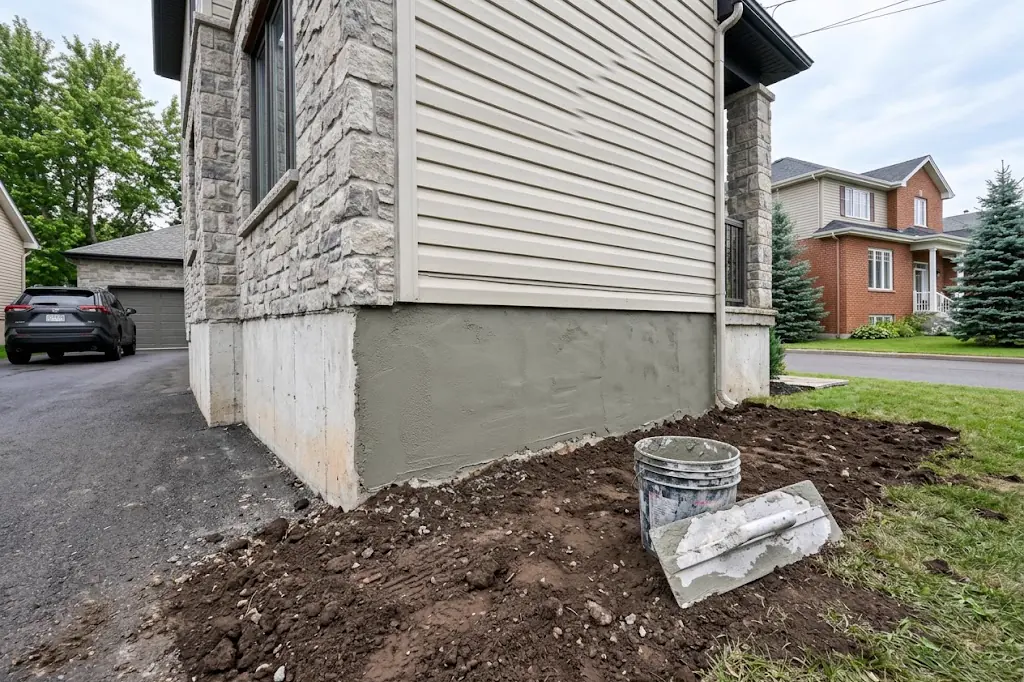
This page covers the mortar coat on poured concrete and concrete block foundations. Fieldstone and brick foundations need a different, lime-based approach; see stone restoration. Parging is not basement waterproofing (see the questions below).
What parging does
Most houses in Greater Moncton have a poured concrete or concrete block foundation with a strip showing above the ground, usually somewhere between a few inches and a couple of feet. Parging covers that strip. It gives the foundation a finished look, hides form marks and block joints, and adds a layer of protection against water, splash and salt. It is not a structural repair and not a waterproofing membrane, but it is the first thing weather hits.
Why parging fails
Parging is one of the most common masonry repairs in New Brunswick, because the foundation strip takes punishment from every direction: rain and roof runoff from above, snow piled against it all winter, salt from the driveway, and moisture coming up from the soil. Common causes of failure:
- Poor bond. Parging applied to smooth, dusty or oily concrete, or without a bonding agent, never grips properly. Water gets behind it, freezes and pops it off in sheets.
- Applied too thick in one coat, or allowed to dry too fast, which causes shrinkage cracks.
- Frost and moisture from behind, especially where soil, mulch or snow sits against the wall above the bottom of the parging.
- Water from above: downspouts dumping at the foundation, missing gutters, or siding and flashing that drain onto the parging.
- Cracks in the foundation that telegraph through the parging.
- Salt from driveways, walkways and steps.
Signs it’s time to redo it
- Parging that sounds hollow when tapped, even where it still looks intact
- Pieces falling off, exposing bare concrete or block
- Spiderweb or map cracking across the surface
- Bubbling, blistering or flaking paint on parging
- Crumbling along the bottom edge near the soil line
- Rust stains or exposed rebar on poured walls, which should be looked at
Patching small areas is possible, but if large parts sound hollow, the rest usually isn’t far behind. Removing all the loose material and redoing the wall gives a more even, longer-lasting finish.
How we parge a foundation
- Dig down. We dig back a few inches below grade so the new parging extends slightly below the soil line rather than stopping at it.
- Remove failed parging. Loose and hollow material is chipped off down to sound concrete or block.
- Repair the wall. Cracks are routed out and filled; spalled concrete is patched; exposed rebar is cleaned and treated.
- Prepare the surface. The wall is cleaned, roughened where it’s smooth, dampened and coated with a bonding agent.
- Apply in coats. A first coat is scratched to give the second coat something to grip, then a finish coat is applied and floated or brushed to the texture you want. Two thin coats hold far better than one thick one.
- Cure. New parging is misted and shaded as needed so it doesn’t dry too fast, and protected from frost.
- Backfill and grade. Soil goes back with a slope away from the house.
Where siding or a sill plate sits on top of the foundation, the top edge of the parging should finish under a flashing or drip edge, not tight against the siding, so water runs off instead of soaking in behind.
Parging falling off your foundation? Send a photo; we can usually tell from that whether it’s a patch or a full redo.
Call (506) 406-6730Send detailsMaterials
Most parging here is a Portland cement and sand mix, often with lime and an acrylic or polymer additive for better bond and flexibility. Pre-bagged polymer-modified parging mixes are also common and consistent. On old fieldstone or brick foundations, a lime-based parge is usually the better choice (see stone restoration), because a hard cement parge over old masonry tends to trap moisture and come off. Finishes range from smooth float to sponge or broom texture. Parging can be left natural grey or coated with a breathable masonry coating.
Why parging fails so often here
Most houses built in Dieppe, Riverview and Moncton over the last few decades sit on poured concrete foundations with a strip of parging showing above the soil. A lot of the soil around Greater Moncton is clay-heavy, so it holds water against the foundation. Add snowbanks piled against the wall all winter and the spring melt, and the bottom edge of the parging stays wet for months at a time.
On many newer homes the parging was applied quickly, in one thick coat, during construction. Those are the walls where we see whole sheets coming away after a few winters. The fix lasts much longer when it comes with a downspout extension or a little regrading so water runs away from the house.
What affects the cost
- Linear feet of wall and the exposed height
- How much old parging has to come off
- Foundation repairs needed underneath: cracks, spalls, exposed steel
- Access: decks, steps, plantings, and tight side yards
- Digging and regrading along the wall
- Finish and coating choices
Parging questions
How long does parging last?
Parging applied to a well-prepared wall, in two coats, with water kept away from the foundation, can last many years. Parging on a wet foundation with poor drainage may need work much sooner, which is why we look at gutters and grading too.
Does parging waterproof my basement?
No. Parging protects the exposed part of the foundation from weather. Basement leaks come from below grade and need drainage or exterior waterproofing. Cracks that let water in can be repaired, and we can point you to waterproofing if that’s the real issue.
Can you parge over the old parging?
Only where the old parging is fully bonded and sound. Going over hollow or loose parging just means both layers come off together. Loose material has to come off first.
When is the best time to parge?
Late spring through early fall, once the ground has dried out and overnight lows stay above about 4 °C. Parging can’t go onto a frozen or frost-covered wall, and it needs a few days without frost while it cures. Very hot, sunny days are a problem too, because the thin coat dries before it bonds, so it may be shaded and misted.
Got a masonry problem? Let’s take a look.
Call to describe the job, or send the form and we’ll call you back. Quotes are free and in writing.
(506) 406-6730- Free on-site look and a written quote
- We explain the cause, not just the symptom
- Moncton, Dieppe, Riverview, Shediac and area